
Our Technique: CRDS?
The Science Behind the Next Generation of NO₂ Monitoring.
What Is CRDS?
Cavity Ring-Down Spectroscopy (CRDS) is one of the most sensitive optical measurement techniques available for trace gas analysis.
Originally developed for demanding scientific and research applications, CRDS has become widely recognized for its ability to detect extremely low gas concentrations with exceptional accuracy and stability.
Unlike conventional analyzers that rely on indirect detection methods, CRDS directly measures how specific molecules absorb light. This provides a highly selective and highly sensitive measurement of the target gas. Our CRDS analyzer, the G60, was developed with patented self-aligning optical cavities to further enhance measurement stability, performance, and ease of operation.
How It Works
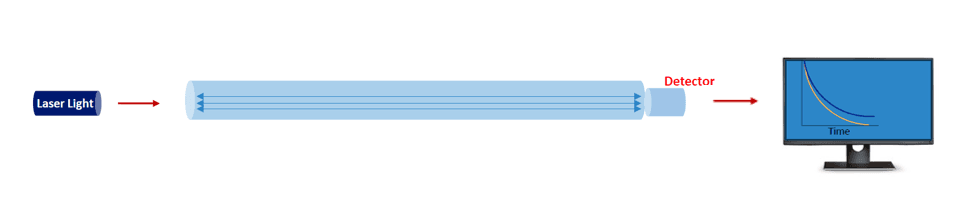
Light (pulse of electromagnetic radiation) is introduced into a high-finesse optical cavity. Trapped light in the cavity reflects thousands of times between two mirrors, creating an effective optical path length of several kilometers within a compact instrument.
As the light travels back and forth, a small fraction of this light escapes through each mirror and when the input light is cut off, its intensity decays exponentially – this is called “ring-down.” The total ring-down time is measured and a first order exponential fit is used to obtain the ring-down time constant. This is used to calculate the concentration of target gases.
As target molecules pass through the cavity, they absorb a small amount of light.
Although the measurement is fundamentally based on Beer Lamberts law, CRDS is time-based instead of intensity-based and hence provides more accurate and repeatable concentration measurement.
Why Scientists Trust CRDS
CRDS has been used extensively in:
- Atmospheric research
- Climate studies
- Trace gas monitoring
- Environmental science
- Industrial process monitoring
- Academic laboratories worldwide
The technology has earned a reputation for delivering reliable measurements at extremely low concentrations.
Advantages of CRDS
- Direct Optical Measurement
- Target molecule is measured directly using laser absorption spectroscopy.
- Exceptional Sensitivity
- Detect trace concentrations with high precision and low noise.
- Excellent Long-Term Stability
- CRDS technology is inherently stable and well-suited for long-term monitoring applications.
- Fast Response
- Capture rapidly changing atmospheric conditions in real time.
- Minimal Interference
- Highly selective optical detection minimizes susceptibility to cross-interference from other gases.
- Reduced Dependence on Converters
- Direct optical measurement reduces uncertainty associated with indirect measurement approaches.
Bringing Laboratory Performance to the Field
Historically, CRDS technology was primarily used in research laboratories.
Direct Optics developed the G60 to bring laboratory-grade performance into a rugged, field-deployable analyzer suitable for continuous operation.
The G60 combines advanced dual-channel CRDS technology with practical features required by environmental monitoring professionals, including:
- Continuous NO₂ and NOx monitoring
- Industrial communications interfaces
- Automated calibration support
- Long-term unattended operation
- Real-time data reporting
