
Our Niche
Direct Measurement | Dual-Channel | Sub-second response time | Parts Per Trillion Detection Limit
The Challenge
Accurate measurement of NO₂ and NOx is becoming increasingly important for regulatory monitoring, atmospheric research, emissions characterization, and public health studies.
However, many conventional monitoring systems were originally designed around a single measurement channel. To determine multiple species, these systems alternate between measurement modes using switching valves, converters, or sequential sampling techniques.
While widely accepted, these approaches can introduce challenges when concentrations change rapidly.
The Hidden Cost of Alternating Sampling
When an analyzer alternates between measurement modes, each species is measured at a slightly different point in time. In stable conditions, this may have little impact. However, in dynamic environments such as roadside monitoring, industrial emissions, or plume tracking, concentrations can change dramatically within seconds.
Potential consequences include:
- Temporal offsets between measurements
- Sample lag
- Switching-valve artifacts
- Increased measurement noise
- Reduced confidence during rapidly changing events
- Difficulty characterizing transient emission sources
For applications requiring high temporal resolution, these effects can become increasingly important but it is expensive to implement.
A Different Approach
The Direct Optics G60 was designed around a fundamentally different architecture.
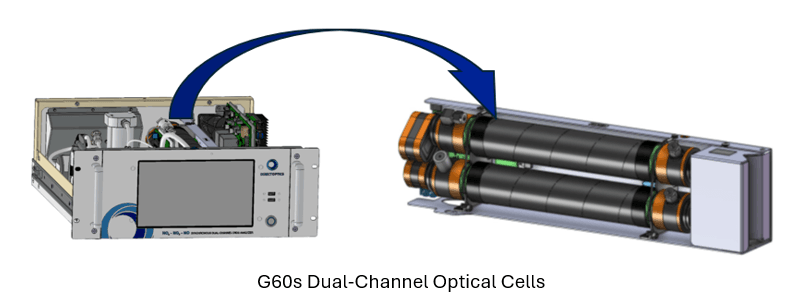
Rather than alternating between measurement modes, the analyzer uses two independent CRDS channels operating simultaneously.
One channel directly and continuously measures Nitrogen Dioxide (NO₂).
A second channel continuously measures total Oxides of Nitrogen (NOx).
Because both channels operate continuously, with the residence time in each channel less a second, the G60 captures the same air mass at the same time.
No switching.
No waiting.
No alternating mode measurement with a single detector.
Benefits of Simultaneous Measurement
- True Real-Time Monitoring
- Continuous measurements provide a more accurate representation of rapidly changing atmospheric conditions.
- Improved Event Detection
- Capture short-duration concentration spikes that may be partially masked by alternating measurement techniques.
- Better Plume Characterization
- Track industrial, traffic, and combustion-related emissions with improved temporal accuracy.
- Enhanced Data Confidence
- Eliminate uncertainty associated with timing differences between measurement modes.
- Improved Data Completeness
- Continuous operation supports uninterrupted monitoring during rapidly evolving atmospheric events.
Ideal Applications
- Near-Road Monitoring
- Measure traffic-related NO₂ and NOx where concentrations can change rapidly.
- Mobile Monitoring
- Support high-resolution spatial mapping of urban and industrial emissions.
- Industrial Fence-Line Monitoring
- Capture transient emissions and process upsets in real time.
- Research Applications
- Provide continuous datasets for atmospheric chemistry and air quality studies.
- Regulatory Monitoring Networks
- Improve confidence in NO₂ and NOx measurements under a wide range of operating conditions.
Why It Matters
The atmosphere does not change in hourly averages.
It changes second by second.
A measurement system designed to continuously monitor NO₂ and NOx simultaneously provides a more complete picture of real-world atmospheric behavior.
